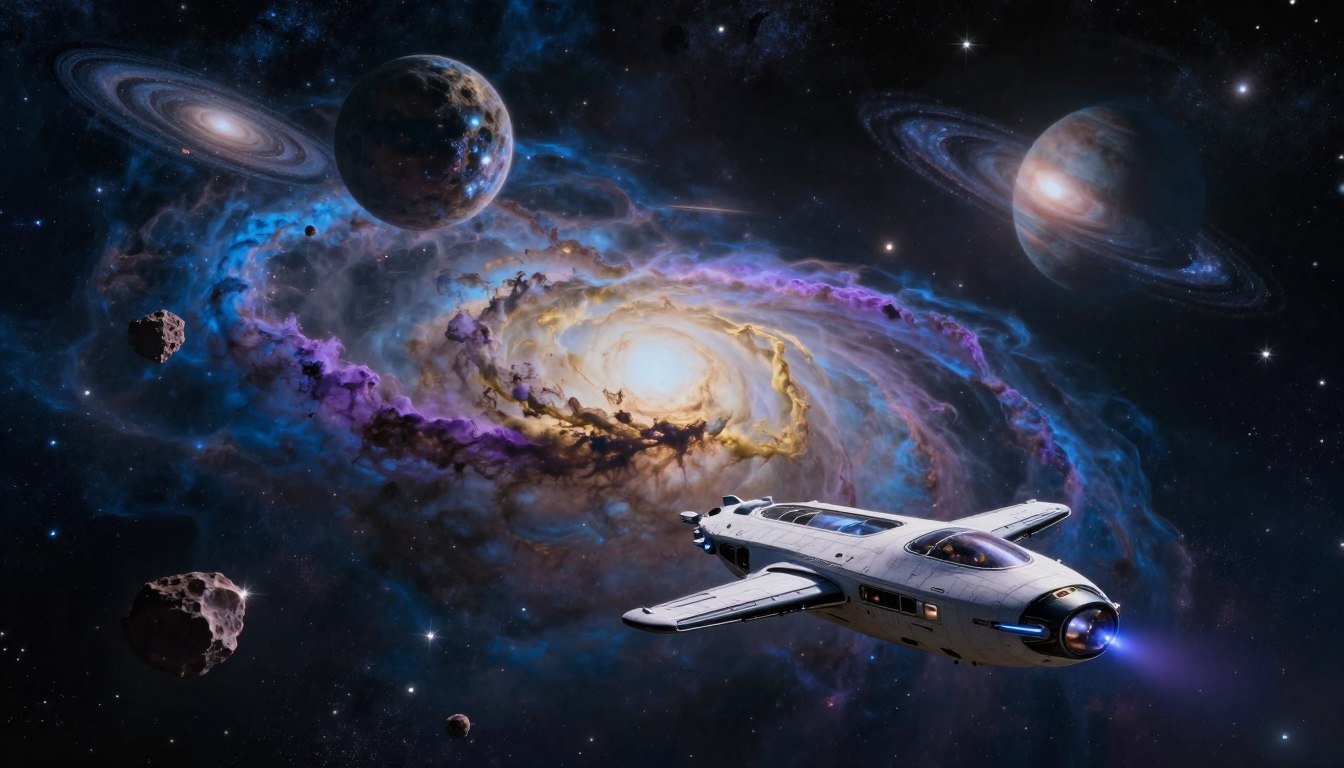
The vast expanse above us has always fascinated us. When we look up at the night sky, we see the huge Universe. It makes us wonder about our place in it.
Today, science is uncovering the secrets of the cosmic mysteries that have puzzled us for so long. With new technology and endless curiosity, we’re learning about the forces that shape our world.
Our journey through space exploration is key to understanding these mysteries. By exploring, we learn more about the Universe and our role in it.
Key Takeaways
- Humanity has always been driven by a deep desire to understand the cosmos.
- Modern scientific tools allow us to observe phenomena previously hidden from view.
- Space exploration provides the data necessary to solve long-standing scientific puzzles.
- Fundamental forces govern the behavior of everything from stars to subatomic particles.
- Continuous research helps us map the evolution of our reality over billions of years.
The Origins and Evolution of the Universe
The story of the cosmos is a fascinating journey from a single point to today’s vast expanse. Scientists have worked for decades to understand how it all began. They use deep space observations and complex math to piece together the Universe’s history.
The Big Bang Theory and Cosmic Inflation
The Big Bang theory is our best explanation for the Universe’s start. It says that about 13.8 billion years ago, the cosmos burst forth from an infinitely hot point. This wasn’t an explosion in space but a rapid expansion of space itself.
Early on, the cosmos went through cosmic inflation. In this brief time, space expanded exponentially, smoothing out any irregularities. This period of accelerated growth laid the groundwork for our world’s physical laws.
“The cosmos is within us. We are made of star-stuff. We are a way for the universe to know itself.”
The Formation of Galaxies and Celestial Structures
After the initial expansion, the cosmos cooled, allowing matter to come together. Gravity pulled particles into the first stars. Over billions of years, these stars formed into massive celestial structures that make up our night sky.
The growth of these structures shows gravity’s power over vast distances. As matter clumped, it created the complex web of galaxies we study today. The table below shows key milestones in this cosmic development.
| Era | Timeframe | Key Event |
|---|---|---|
| Inflationary Epoch | 0 to 10^-32 seconds | Rapid expansion of space |
| Recombination | 380,000 years | Formation of neutral atoms |
| Stellar Birth | 200 million years | First stars and galaxies form |
| Modern Era | 13.8 billion years | Current state of the Universe |
Understanding these processes helps us see the intricate balance needed for life. Every galaxy and star cluster is a result of ancient physical interactions. As technology advances, we learn more about the Universe‘s history.
Dark Matter and Dark Energy: The Invisible Forces
When we gaze at the night sky, we see stars, planets, and glowing nebulae. Yet, these visible objects make up only a small part of the universe. The rest is made up of two mysterious entities that our telescopes can’t see.
These cosmic mysteries shake the foundations of modern astrophysics. Scientists believe that about 95% of the universe is made of things we can’t detect with light or radiation.
Defining the Unseen Components of the Cosmos
To grasp the universe, we must understand two main invisible forces. Dark matter is like invisible glue, while dark energy is a mysterious force pushing everything apart.
“The universe is not only queerer than we suppose, but queerer than we can suppose.”
Researchers group these components by their effects on the visible world. Though unseen, their impact is clear in galaxy movements and the universe’s growth.
How Dark Energy Accelerates Cosmic Expansion
Dark energy is a repulsive force that fills all space. It fights against gravity, making the cosmic expansion speed up instead of slow down.
- It makes up about 68% of the universe’s total energy.
- It pushes galaxies away from each other faster and faster.
- It hints that the future universe will be cold and empty.
This acceleration is a major puzzle in science today. Without it, the universe might have collapsed back on itself long ago.
The Role of Dark Matter in Galactic Stability
While dark energy pushes, dark matter pulls. It’s the gravitational framework that lets structures form.
Without dark matter, galactic stability wouldn’t be possible. Galaxies rotate so fast they should fly apart, but they stay together because of this invisible mass.
This unseen material is like a cosmic anchor for stars and gas clouds. By studying these interactions, astronomers are slowly uncovering the secrets of our reality.
Black Holes and the Curvature of Spacetime
When matter collapses, it warps the fabric of reality. These areas, called black holes, are the most extreme places in the universe. The spacetime curvature is so strong that it tests the limits of physics.
Understanding Event Horizons and Singularities
The event horizon marks the edge of a black hole. It’s where gravity is so strong that not even light can escape. Once past this point, an object is cut off from the rest of the universe.
At the heart of a black hole lies the singularity. It’s a point of infinite density where spacetime curves vertically. Our current math can’t fully describe it, but it’s a key area of study for gravity researchers.
Gravitational Waves as Messengers from the Deep
Black holes communicate through gravitational waves. These are ripples in spacetime caused by huge events, like black hole collisions. As these waves travel, they share information about the events that made them.
The Significance of LIGO Observations
The Laser Interferometer Gravitational-Wave Observatory, or LIGO, has changed our view of the universe. It detects these tiny vibrations, proving the existence of gravitational waves. This discovery has opened a new way to explore the universe, allowing us to “hear” invisible events.
| Feature | Description | Impact |
|---|---|---|
| Event Horizon | Boundary of no return | Traps light and matter |
| Singularity | Point of infinite density | Challenges physics laws |
| Gravitational Waves | Spacetime ripples | Reveals cosmic collisions |
The Search for Extraterrestrial Life
The search for extraterrestrial life is a major challenge in science today. Scientists use advanced tools to look for signs of life in space. This search is based on solid data and the study of planets.
Habitable Zones and Exoplanet Discovery
Thousands of exoplanets have changed how we see our galaxy. Many of these planets are in habitable zones. This area has temperatures that could support liquid water, a key for life.
Scientists study these planets to see if they can support life. By looking at the light passing through their atmospheres, they can find signs of water, methane, and oxygen. These signs help plan missions to find life.
| Planet Type | Distance from Star | Atmospheric Potential | Life Probability |
|---|---|---|---|
| Gas Giant | Far | High Pressure | Low |
| Rocky Super-Earth | Optimal | Moderate | High |
| Ice Dwarf | Very Far | Thin | Very Low |
The Drake Equation and the Fermi Paradox
The Drake Equation helps scientists guess how many alien civilizations might exist. It considers how many stars are born and how many planets might have life.
But, the Fermi paradox asks why we haven’t seen any signs of aliens. Even though the math says there should be many, we’ve found none. This mystery keeps scientists searching.
Maybe the distances are too big, or we’re not good enough at finding life yet. Still, the search is key to understanding our universe. Every new find brings us closer to knowing our place in the cosmos.
Modern Space Exploration and Technological Frontiers
Technological frontiers are growing fast, letting us see more of the universe than ever. These advances are key to understanding the vast mysteries of space. By improving engineering, we’re starting to answer big questions about our place in the infinite universe.
The James Webb Space Telescope and Deep Space Imaging
The James Webb Space Telescope is a huge step forward in seeing the early universe. It uses advanced infrared deep space imaging to capture light from billions of years ago. This lets scientists see the birth of the first stars and galaxies, even through cosmic dust clouds.
This infrared tech is a major breakthrough for astronomy. It lets us see into times that were once hidden. Now, scientists can study the chemistry of distant atmospheres with unprecedented detail.
Future Missions to Mars and Beyond
Looking ahead, Mars missions are a top goal for space agencies worldwide. To set up a human base on Mars, we must solve big problems like life support and energy. These efforts are crucial for our survival and growth.
Right now, we’re focusing on robotic missions to explore Mars and find important resources like water ice. These robots help us prepare for safe human landings. By mastering these technologies, we’re ready for the next big step in human history.
Conclusion
Humanity has reached a special moment in history. Our tools now match our curiosity about the Universe. We’ve moved from simple stargazing to analyzing light from the edge of time. This shift changes how we see our place among the stars.
Modern space exploration gives us the data to solve puzzles like dark matter and black holes. These missions turn abstract theories into real knowledge. Every new image from the James Webb Space Telescope brings us closer to understanding the origins of everything we see.
The search for life drives future missions. We keep pushing boundaries to find answers in distant solar systems. This ongoing quest shows the best of human ambition and intellect.
Stay updated with the latest findings as we explore the unknown. The story of the cosmos is still being written. Your interest in these mysteries supports the vital work of scientists around the globe.